
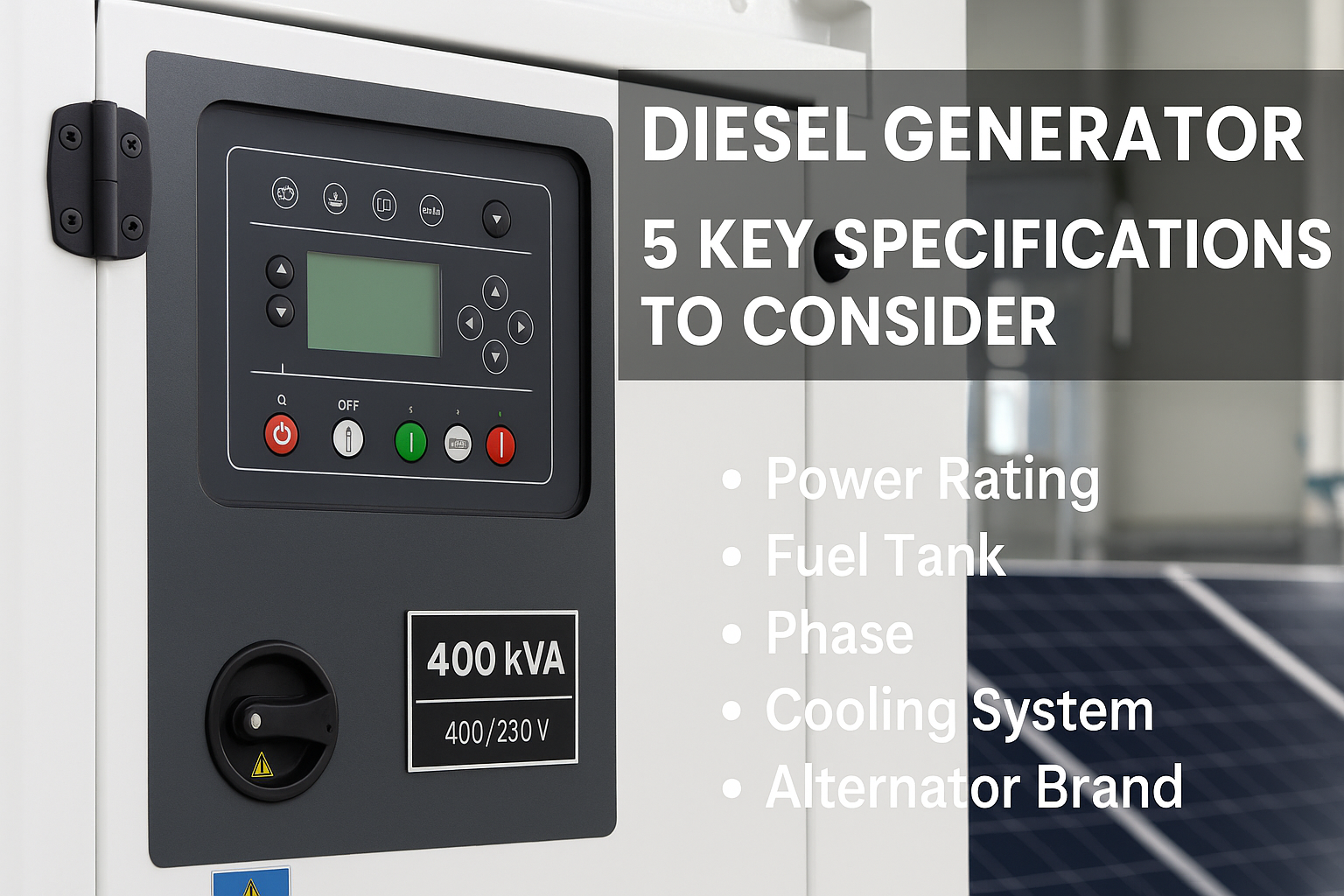
5 Key Specifications to Consider When Purchasing a Diesel Generator
Estimated reading time: 5–6 minutes
When investing in a diesel generator, whether for industrial, commercial, or backup use, selecting the right machine is critical to your project’s performance and efficiency. Beyond brand and cost, you must understand the technical specifications that determine whether the generator will deliver the right power, reliability, and lifespan for your needs.
In this article, we’ll cover five key specifications every buyer should carefully assess before making a purchase decision.
1. Power Rating: Prime, Standby, or Continuous?
The power rating determines how much electrical load the generator can support. It’s typically expressed in kW or kVA. There are three main categories:
-
Standby Power (ESP): For emergency use only, during grid outages. Not suitable for continuous or variable loads.
-
Prime Power (PRP): Ideal for regular use, such as construction sites or remote operations, with variable loads.
-
Continuous Power (COP): Designed for 24/7 operation at constant load levels.
✅ Tip: Never select a generator that operates at 100% load all the time. Aim for 70–80% utilization for longer life.
2. Fuel Tank Capacity & Runtime
Evaluate the size of the fuel tank in relation to your expected runtime and refueling logistics. Diesel generators often come with tanks designed for:
-
8–10 hours
-
24 hours
-
48 hours (or external tanks)
Choose based on how often refueling is feasible. For remote operations, a 24+ hour fuel tank may reduce operational interruptions and labor costs.
3. Voltage & Phase Configuration
You’ll need to choose between single-phase or three-phase generators:
| Use Case | Voltage & Phase Recommendation |
|---|---|
| Residential / Light commercial | Single-phase (220–240V) |
| Industrial / Construction | Three-phase (380–480V) |
Also consider voltage stability, especially for sensitive equipment. Ask for voltage regulation features or AVR (Automatic Voltage Regulation) if applicable.
4. Cooling System: Air-Cooled vs Water-Cooled
Cooling mechanisms directly affect generator performance and durability:
-
Air-Cooled Generators: Simpler, compact, ideal for small/portable units.
-
Water-Cooled Generators: Better for high power outputs and long-duration operation. More efficient at heat dissipation.
🌡️ For tropical or hot climate regions, always opt for water-cooled systems with proper radiator capacity.
5. Alternator Brand & Quality
The alternator is a core component that converts mechanical energy into electrical output. Trusted alternator brands include:
-
Stamford (UK)
-
Leroy Somer (France)
-
Marathon (USA)
-
Copy-Stamford / OEM (Cost-effective alternatives)
Key aspects to check:
-
Efficiency rating
-
Brushless design (for lower maintenance)
-
Insulation class (Class H is preferred)
-
IP protection level
While OEM alternators may lower initial cost, branded alternators offer better voltage stability, longer service life, and global support.
Bonus Considerations
-
Noise Level (dBA): If operating in residential or public spaces, select silent or soundproof models.
-
Control Panel & ATS Compatibility: Ensure ease of operation, remote monitoring, and automatic transfer switch (ATS) support.
-
Emissions Compliance: Verify if it meets local standards like EU Stage III or EPA Tier II–IV.
-
Portability: Trailer or skid-mounted designs for mobile use.
Conclusion
Purchasing a diesel generator is a technical decision that impacts power continuity, fuel efficiency, and long-term reliability. By evaluating these five critical specifications—power rating, tank capacity, voltage phase, cooling system, and alternator brand—you can ensure your investment delivers the performance and value you expect.
Author: Technical Sales Team – [Ningde City Lion Motor Co., Ltd.]
Last updated: June 24, 2025