
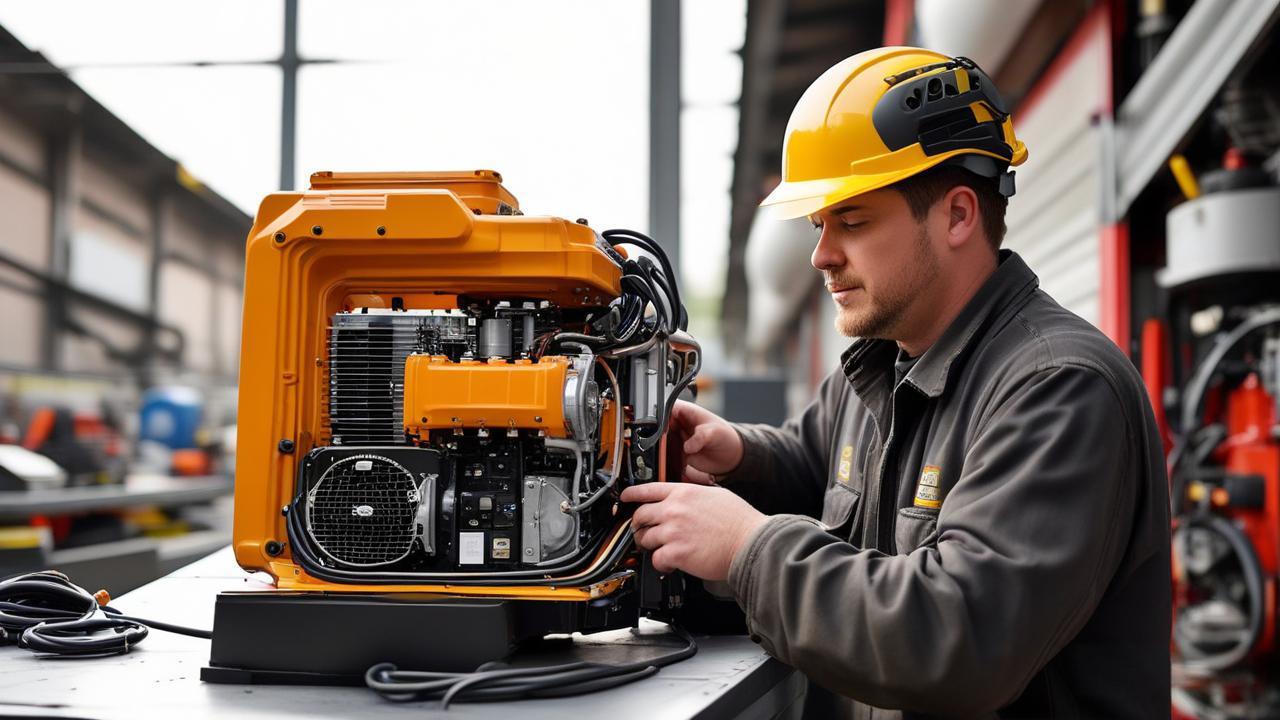
How Diesel Generators Work: A Clear, Engineer-Level Guide for Everyone
Estimated reading time: 8 minutes
Diesel generators (often shortened to “diesel gensets”) are the backbone of reliable power for construction sites, data centers, mines, ships, and entire islands. Yet many decision-makers only see the metal box—missing the fascinating electromechanical process inside. In this guide you will learn:
-
Core components and what each does
-
The step-by-step energy conversion cycle
-
Key factors that affect performance and fuel efficiency
-
Answers to frequently asked questions from real buyers
1. Core Components and Their Roles
| Component | Primary Function | Typical Materials/Specs |
|---|---|---|
| Diesel Engine | Converts chemical energy in diesel fuel into rotational mechanical energy | Cast-iron block, turbocharged, 1,500–1,800 rpm for 50/60 Hz output |
| Alternator (AC Generator Head) | Converts mechanical rotation into AC electricity via electromagnetic induction | Copper windings, laminated steel rotor/stator |
| Fuel System | Stores, filters, and injects diesel at precise pressure & timing | Day tank, primary & secondary filters, high-pressure injectors |
| Lubrication System | Reduces friction & heat in moving parts | Oil pump, gallery passages, spin-on filter, oil cooler |
| Cooling System | Maintains safe operating temperature | Radiator, water pump, thermostat, glycol coolant |
| Air Intake & Exhaust | Supplies oxygen and expels combustion gases | Turbocharger, aftercooler, muffler, catalytic options |
| Control Panel & Governor | Monitors parameters, regulates speed, synchronizes to loads | Digital controller (PLC/ECU), electronic governor, protective relays |
| Starting System | Brings engine to cranking speed | 24 V DC starter motor or pneumatic starter & batteries |
| Base Frame & Vibration Isolators | Aligns components, contains fluids, reduces noise | Rugged steel skid, anti-vibration mounts |
2. The Energy Conversion Cycle—From Fuel to Flowing Electrons
-
Air Induction
Ambient air is drawn through the air filter. In turbocharged engines, a turbine driven by exhaust gases compresses this air, boosting oxygen density for cleaner, more powerful combustion. -
Fuel Injection
The engine’s ECU meters diesel through high-pressure common-rail injectors (up to 2,500 bar). Atomized fuel mixes evenly with the compressed, hot air. -
Compression & Combustion
Unlike gasoline engines, diesel engines use compression ignition. Air is compressed to ~16–20 : 1; temperature rises beyond 550 °C. Injected fuel ignites spontaneously, forcing the piston downward and turning the crankshaft. -
Mechanical Rotation
The crankshaft drives the rotor of the alternator at a fixed synchronous speed (1,500 rpm for 50 Hz or 1,800 rpm for 60 Hz systems). A flexible coupling or direct SAE flange transmits torque. -
Electromagnetic Induction
As the rotor’s electromagnets spin inside the stator windings, they induce an alternating current (AC). Voltage regulators adjust the rotor’s excitation current, keeping output within ±1 % of the set voltage. -
Power Delivery & Regulation
The control panel senses voltage, frequency, current, oil pressure, coolant temperature, and more. An electronic governor trims fuel to keep frequency stable as load fluctuates. If parameters wander outside safe limits, protective relays trip to prevent damage.
3. Factors Affecting Performance & Fuel Efficiency
| Factor | Impact | Optimization Tips |
|---|---|---|
| Load Factor | Diesel engines run most efficiently at 60–80 % of rated load. Light-loading (<30 %) leads to wet-stacking and carbon buildup. | Select a genset size that matches typical load or install load-banks for periodic “exercise.” |
| Ambient Temperature & Altitude | Higher temps and altitudes lower air density ⇒ derating required. | Use aftercoolers, high-capacity radiators; consult ISO 8528-1 derating charts. |
| Fuel Quality | Water or sulfur in fuel causes injector wear and corrosive exhaust. | Specify <10 ppm water, <500 ppm sulfur (ASTM D975 No. 2-D). Install water separators. |
| Maintenance Regime | Dirty filters and degraded oil raise friction, fuel consumption, and failure risk. | Follow OEM intervals: oil every 250 hrs, fuel filters every 500 hrs, valves & injectors every 1,000 hrs. |
| Control Strategy | Poor voltage regulation causes motor overheating and inefficient operation. | Use digital AVR with ±1 % regulation, and program under-frequency roll-off. |
| Hybrid Integration | Pairing with batteries or solar can reduce runtime and fuel burn by 30-50 %. | Add an intelligent EMS that prioritizes renewable input and auto-starts genset only when SOC < 30 %. |
4. Frequently Asked Questions
Q1: How long can a diesel generator run continuously?
Industrial units with large day tanks and automatic lube-oil top-up can run 24/7 for 500-750 hours before scheduled shutdown. Always check OEM limits.
Q2: Is a diesel generator safe for sensitive electronics?
Yes—if equipped with a modern AVR and total harmonic distortion (THD) < 5 %. Adding an uninterruptible power supply (UPS) provides extra battery buffering for critical loads.
Q3: What emissions regulations apply outside the U.S.?
European Stage V, China IV, and IMO Tier III for marine. Many developing markets still accept Tier II engines, but trends favor cleaner combustion and SCR after-treatment.
Q4: Can I parallel multiple generators?
Absolutely. Digital controllers synchronize voltage, phase, and frequency, allowing N+1 redundancy and scalable capacity. Ensure identical voltage & frequency ratings.
5. Key Takeaways
-
Diesel generators convert chemical energy to electrical energy via the compression-ignition diesel cycle and electromagnetic induction.
-
Understanding each component helps you diagnose faults, optimize fuel use, and extend service life.
-
Proper sizing, quality fuel, and scheduled maintenance can cut operating costs by up to 15 % over the genset’s lifecycle.
Author: Technical Engineering Team – [Ningde City Lion Motor Co., Ltd.]
Last updated: 29 May 2025